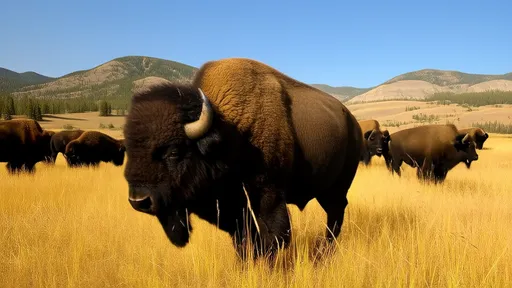
The vast wilderness of Yellowstone National Park serves as a sanctuary for North America's largest land mammal—the American bison. Often mistakenly called buffalo, these iconic creatures have become a symbol of resilience and conservation success. Their story is one of near extinction and remarkable recovery, intertwined with the history of the American West and the evolving understanding of wildlife management.
For centuries, bison roamed the Great Plains in staggering numbers, with estimates suggesting populations once exceeded 30 million. Native American tribes relied on these massive herbivores for food, clothing, and cultural significance. However, the late 19th century brought indiscriminate hunting and westward expansion that reduced their numbers to fewer than 1,000 individuals by 1889. Yellowstone became their last stronghold, sheltering the final wild herd that would eventually repopulate much of their former range.
The park's unique geothermal features created winter grazing areas that allowed bison to survive when snow buried other food sources. These natural advantages, combined with early protection efforts, helped the Yellowstone herd persist through the darkest days of bison conservation. Today, Yellowstone's bison represent the longest continuous wild population in North America, offering scientists invaluable insights into undisturbed bison behavior and ecology.
Modern conservation efforts face complex challenges as bison populations rebound. The park currently sustains about 5,000 animals—a number that fluctuates based on environmental conditions and management decisions. This thriving population creates tensions with surrounding livestock operations concerned about disease transmission, particularly brucellosis. The bacterial infection can cause cattle to abort calves, though no documented cases exist of bison transmitting brucellosis to cattle in the wild.
Migration patterns have emerged as a critical conservation issue. As bison follow ancient instincts to leave the park in search of winter forage, they encounter political boundaries and conflicting stakeholder interests. State and federal agencies collaborate on management plans that attempt to balance ecological needs with agricultural concerns, often employing a mix of hazing, hunting, and quarantine protocols to control population growth and movement.
The cultural significance of bison continues to grow alongside their ecological recovery. In 2016, the species was designated as the U.S. national mammal, recognizing its importance to American heritage. Native American tribes have taken leadership roles in restoration efforts, with several maintaining conservation herds on tribal lands. These initiatives blend traditional knowledge with modern science, creating innovative approaches to bison stewardship.
Visitors to Yellowstone often experience their first bison encounter with a mix of awe and caution. These animals, while seemingly docile as they graze, can sprint up to 35 mph and become aggressive when threatened. Park regulations require maintaining at least 25 yards of distance—a rule frequently tested by tourists seeking close-up photographs. Each year, injuries occur when visitors underestimate the power and unpredictability of wild bison.
Scientific research has revealed fascinating aspects of bison biology and behavior. Their grazing patterns create ecological niches for other species, earning them recognition as a keystone species. Wallowing behavior—rolling in dirt to deter insects—creates depressions that collect water and support unique plant communities. Even their massive heads serve as snowplows in winter, clearing access to buried grasses for themselves and other herbivores.
Climate change presents new uncertainties for Yellowstone's bison. Warmer temperatures may alter the park's delicate balance of geothermal areas and winter forage availability. Researchers monitor how shifting precipitation patterns affect the quality and distribution of grasses, while modeling potential impacts on herd health and migration timing. These studies help inform adaptive management strategies for an uncertain future.
The story of Yellowstone's bison offers hope and lessons for global conservation efforts. From the brink of extinction, these majestic animals have reclaimed their place in the American landscape. Their continued recovery depends on finding solutions that honor ecological needs, cultural values, and economic realities—a challenge as immense as the bison themselves.
As sunlight filters through the steam of Yellowstone's hot springs, illuminating a herd grazing in the distance, visitors witness a living testament to conservation's potential. The bison's deep grunts and the thunder of hooves across the valley floor echo a legacy that nearly vanished, now growing stronger with each passing year. In their massive frames and stubborn perseverance, we see reflections of our own relationship with the natural world—at times destructive, but capable of remarkable redemption.
By /Jun 10, 2025
By /Jun 10, 2025
By /Jun 10, 2025
By /Jun 10, 2025
By /Jun 10, 2025
By /Jun 10, 2025
By /Jun 10, 2025
By /Jun 10, 2025
By /Jun 10, 2025
By /Jun 10, 2025
By /Jun 10, 2025

By /Jun 10, 2025
By /Jun 10, 2025
By /Jun 10, 2025
By /Jun 10, 2025

By /Jun 10, 2025
By /Jun 10, 2025
By /Jun 10, 2025
By /Jun 10, 2025
By /Jun 10, 2025
