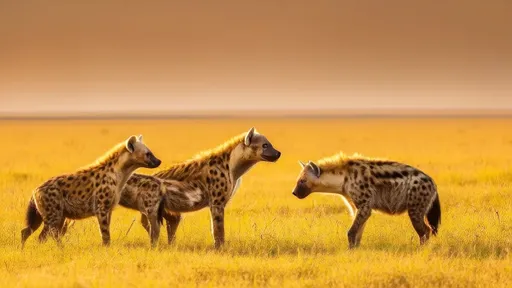
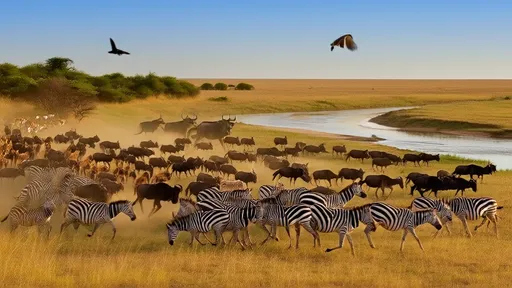
The vast golden plains of the Serengeti hold many secrets, but few are as fascinating as the complex social dynamics of its spotted hyena clans. These misunderstood predators have long been vilified in popular culture, yet their intricate matriarchal society and highly coordinated hunting strategies reveal a sophistication that rivals even the most celebrated African carnivores.
Beneath the full moon's glow, a chorus of whooping calls echoes across the savanna as a hyena clan mobilizes for the night's hunt. What appears as chaos to the untrained eye is in fact a meticulously organized operation, with each female knowing her precise role in the coming pursuit. Unlike the male-dominated hierarchies of lion prides, hyena clans flip traditional gender roles on their head, creating one of nature's most compelling matriarchies.
The matrilineal structure of hyena society begins at birth, with female cubs inheriting their mother's social rank. High-ranking females enjoy priority access to food and mating opportunities, while their male counterparts - even those physically larger - occupy the lower rungs of the clan's social ladder. This inversion of typical mammalian social structures has fascinated researchers for decades, challenging long-held assumptions about gender roles in predator species.
Hunting as a sisterhood takes on new meaning in hyena clans. Females often lead hunting parties, working together with military precision to isolate and exhaust prey. Their famous stamina comes into play during prolonged chases, where they alternate between sprinters and fresh reinforcements to wear down even the fastest antelope. Nighttime thermal imaging has revealed how hunting parties maintain constant communication through subtle body language and vocalizations too high-pitched for human ears.
The cooperative nature of hyena hunts extends beyond the actual pursuit. After a successful kill, the spoils are distributed according to strict social hierarchy, with dominant females and their cubs eating first. Contrary to their scavenger reputation, research shows that hyenas procure up to 75% of their food through active hunting, often outpacing lions in both hunting success rates and carcass protection.
What truly sets hyena society apart is the remarkable physical dominance of females. Through an evolutionary quirk, female hyenas possess pseudo-penises (enlarged clitorises) that make them nearly indistinguishable from males at first glance. This unusual anatomy, combined with higher testosterone levels than their male counterparts, allows females to completely control mating encounters and reinforces their social dominance.
The sisterhood extends to cub-rearing as well. While mothers are primarily responsible for their offspring, the entire clan participates in protecting and educating young hyenas. Cubs learn hunting techniques through elaborate play sessions that mimic actual prey pursuits, with older females often intervening to demonstrate proper form. This communal approach to child-rearing ensures the next generation of females maintains the clan's hunting prowess and social structure.
Recent studies using GPS collars have revealed even more sophisticated hunting behaviors. Some clans maintain detailed mental maps of their territory, remembering precise locations of past successful hunts and seasonal prey movements. Certain matriarchs have been observed leading their clans on deliberate "patrols" along territory borders, reinforcing boundaries through scent marking and vocal displays.
The intelligence required for such complex social and hunting behaviors has led some researchers to compare hyenas to primates in terms of cognitive abilities. Their problem-solving skills during hunts, ability to recognize individual clan members, and sophisticated communication systems suggest a level of intelligence previously underestimated in these remarkable predators.
As climate change alters the Serengeti ecosystem, researchers are closely monitoring how hyena clans adapt. Early observations suggest their flexible social structure and cooperative hunting strategies may give them an advantage over more rigid predator societies. The very traits that made them successful for millennia - female leadership, group cooperation, and remarkable adaptability - may prove crucial for survival in an uncertain ecological future.
For conservationists, understanding hyena matriarchies has become essential for protecting the delicate balance of African ecosystems. As nature's ultimate sisterhood of the savanna, these formidable hunters play a crucial role in controlling herbivore populations and recycling nutrients through the food web. The next time a hyena's laugh echoes across the plains, listen closely - it's the sound of one of evolution's most successful social experiments.
By /Jun 10, 2025
By /Jun 10, 2025
By /Jun 10, 2025
By /Jun 10, 2025

By /Jun 10, 2025
By /Jun 10, 2025

By /Jun 10, 2025
By /Jun 10, 2025
By /Jun 10, 2025
By /Jun 10, 2025

By /Jun 10, 2025
By /Jun 10, 2025
By /Jun 10, 2025
By /Jun 10, 2025

By /Jun 10, 2025

By /Jun 10, 2025
By /Jun 10, 2025
By /Jun 10, 2025

By /Jun 10, 2025
By /Jun 10, 2025
