Deep in the heart of the Indian Ocean lies an island so extraordinary that it defies biological expectations. Madagascar, a landmass accounting for less than 0.5% of Earth’s surface, cradles an astonishing secret within its rainforests, deserts, and mangroves—it is the undisputed kingdom of chameleons. This remote island harbors nearly two-thirds of the world’s chameleon species, a statistic that leaves even seasoned herpetologists breathless. These creatures, with their spiraled tails, independently rotating eyes, and kaleidoscopic skin, are not merely inhabitants of Madagascar; they are living brushstrokes in an evolutionary masterpiece painted over 60 million years of isolation.
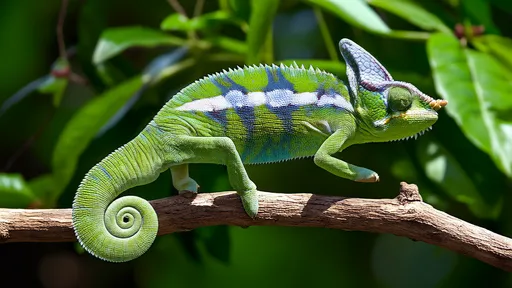
The story of Madagascar’s chameleon dominance begins with geology. When the supercontinent Gondwana fractured, this island drifted away like a botanical ark, carrying an ancestral chameleon population that would diversify in spectacular isolation. Unlike continental chameleons constrained by competition, Madagascar’s reptiles exploded into niches unimaginable elsewhere. The result? A carnival of forms—from the thumbnail-sized Brookesia micra (smaller than a human fingernail) to the Furcifer oustaleti, a 70-centimeter-long giant that prowls thorn forests like a miniature dragon. Some wear horns worthy of medieval crests (Trioceros species), while others mimic dead leaves (Brookesia superciliaris) with such precision that they vanish before a predator’s eyes.
What makes Madagascar’s chameleons particularly mesmerizing is their role as ecological barometers. In the eastern rainforests, the Calumma parsonii—a turquoise-skinned jewel—changes color not just for camouflage but to communicate emotional states, its hues shifting like mood rings. Meanwhile, in the arid southwest, the Furcifer labordi completes its entire life cycle within a single year, a fleeting existence synchronized with seasonal rains. These adaptations aren’t random quirks; they’re survival strategies honed through epochs of climatic upheaval. When a Brookesia chameleon freezes mid-step, its body swaying like a twig in the wind, it’s performing an ancient dance against extinction.
Yet this living treasure faces modern threats more relentless than any natural predator. Satellite imagery reveals a grim reality: Madagascar has lost nearly 40% of its forests since the 1950s, taking unknown chameleon species with it. Illegal pet trade compounds the crisis—rare species like the Panther chameleon (Furcifer pardalis) fetch astronomical prices on black markets, while slash-and-burn agriculture turns microhabitats to ash. Conservationists now race against time, employing drones to map remaining populations and training local communities as biodiversity guardians. In a bittersweet twist, new species are still being discovered even as their habitats vanish; five chameleon species were described in 2022 alone from dwindling forest fragments.
The cultural tapestry of Madagascar intertwines deeply with these reptiles. In Merina tribe folklore, chameleons are messengers between the living and ancestors, their color shifts believed to convey spiritual warnings. Modern science echoes this reverence—researchers recently discovered that chameleon skin contains nanocrystals that refract light, a mechanism that could revolutionize adaptive camouflage technology. From sacred symbolism to biomedical inspiration, these creatures embody Madagascar’s duality as both a cradle of ancient wisdom and a wellspring of scientific revelation.
As climate change tightens its grip, Madagascar’s chameleons face a paradoxical future. Some species may adapt through rapid evolutionary shifts (studies show certain Furcifer populations altering egg-laying timing), while others risk becoming climate refugees with nowhere to go. International collaborations now deploy AI-powered camera traps and citizen science initiatives to monitor populations, but the ultimate solution lies in reweaving the island’s shattered ecosystems. Perhaps therein lies the most profound lesson—these color-changing marvels, having survived asteroid impacts and continental drift, now depend entirely on humanity’s willingness to preserve their kaleidoscopic world.
By /Jun 10, 2025
By /Jun 10, 2025
By /Jun 10, 2025
By /Jun 10, 2025
By /Jun 10, 2025
By /Jun 10, 2025
By /Jun 10, 2025
By /Jun 10, 2025
By /Jun 10, 2025
By /Jun 10, 2025
By /Jun 10, 2025
By /Jun 10, 2025
By /Jun 10, 2025
By /Jun 10, 2025
By /Jun 10, 2025
By /Jun 10, 2025
By /Jun 10, 2025
By /Jun 10, 2025
By /Jun 10, 2025
By /Jun 10, 2025
