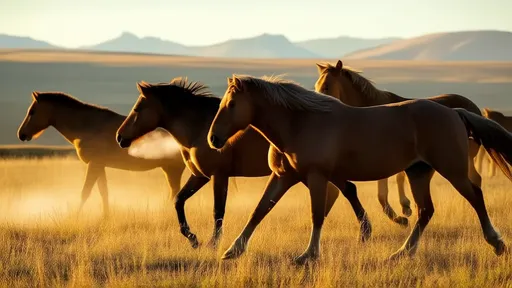
The vast steppes of Central Asia once teemed with herds of wild horses, their hooves pounding across the grasslands in a rhythmic echo of untamed freedom. Among them, the Przewalski's horse, also known as the Mongolian wild horse, stood as a living relic of prehistoric equine lineage. By the mid-20th century, however, this species had vanished from its native habitat, pushed to the brink of extinction by hunting, habitat loss, and competition with domestic livestock. Its survival hinged on a handful of captive individuals scattered across zoos and reserves. What followed was one of the most ambitious conservation efforts in modern history—a decades-long mission to return the Przewalski's horse to the windswept plains of Mongolia.
The Last Truly Wild Horse
Unlike mustangs or brumbies, which are feral descendants of domesticated horses, the Przewalski's horse is the last remaining subspecies of wild horse never to have been tamed by humans. Stockier than their domestic relatives, with a dun-colored coat, upright mane, and a distinctive dorsal stripe, these horses are genetically distinct, possessing 66 chromosomes compared to the 64 found in domesticated breeds. Their behavior, too, reflects an ancient wildness—they form tight-knit family groups led by a dominant mare, and stallions fiercely defend their territories. For centuries, they roamed the steppes of Mongolia, China, and Kazakhstan, until human encroachment reduced their numbers to zero in the wild by the 1960s.
The species clung to existence through captive breeding programs, primarily in European zoos. By the 1990s, conservationists faced a critical question: Could these horses, born and raised in enclosures, ever thrive again in the harsh landscapes of their ancestors? The answer lay in a series of daring reintroduction projects, beginning with Mongolia's Hustai National Park and later expanding to sites in China and Kazakhstan. The challenges were immense—predation, disease, and the horses' own lack of familiarity with their ancestral environment all posed threats. Yet, against the odds, the first reintroduced herds began to adapt, their instincts slowly reawakening.
Relearning the Wild
Early reintroductions revealed a sobering truth: captivity had dulled the horses' survival skills. Individuals released into Hustai National Park in the 1990s initially struggled to find water, evade wolves, or endure Mongolia's brutal winters. Conservationists responded with a phased approach. Horses were first acclimatized in large enclosures within the release sites, allowing them to experience natural conditions while still receiving supplemental feeding. Over time, they were granted increasing freedom, with researchers closely monitoring their progress. This "soft release" method proved crucial, giving the animals time to develop essential behaviors like seasonal migration and foal-rearing in the wild.
Genetic diversity posed another hurdle. All living Przewalski's horses descend from just 12 founders, creating a population bottleneck that threatened the species' long-term viability. To address this, international collaborations began exchanging breeding individuals between reintroduction sites and captive populations. Advances in genetic testing allowed scientists to strategically pair mates, maximizing diversity. Meanwhile, habitat restoration efforts sought to recreate the mosaic of grasslands and water sources that once sustained wild herds. In Mongolia's Gobi Desert region, conservation teams worked with local herders to reduce competition for grazing land, demonstrating that human livelihoods and wildlife recovery could coexist.
Signs of Success
Today, the sight of Przewalski's horses galloping across the Mongolian steppe is no longer a fantasy. From fewer than 30 individuals in captivity during the 1940s, the global population now exceeds 2,000, with nearly 400 roaming free in reintroduction sites. Hustai National Park alone hosts over 400 horses across multiple generations born in the wild—a testament to the project's success. Perhaps most remarkably, these once-captive animals have reclaimed their ecological role. Their grazing patterns help maintain grassland biodiversity, while their presence benefits other endangered species like the Mongolian gazelle.
The horses' return has also sparked cultural renewal among Mongolia's nomadic communities. Once hunted as pests, Przewalski's horses now feature prominently in local folklore and ecotourism initiatives. Herders who once viewed them as competitors for scarce resources have become their protectors, participating in monitoring programs and sharing traditional knowledge about steppe ecology. This cultural shift underscores a growing recognition that the wild horse's survival is intertwined with Mongolia's identity—a symbol of resilience in a rapidly changing world.
Future Challenges
Despite these victories, the Przewalski's horse remains classified as Endangered. Climate change looms as a new threat, altering precipitation patterns and reducing water availability across Central Asia's grasslands. Political instability in some range countries has occasionally disrupted conservation efforts, while illegal hunting persists in remote areas. Conservationists now emphasize the need for transboundary cooperation, as wild horse populations will require interconnected habitats to maintain genetic health. Satellite tracking collars and drone monitoring have become invaluable tools, allowing researchers to study herd movements across vast, inaccessible terrains.
The story of the Przewalski's horse offers both caution and hope—a reminder of humanity's capacity to destroy, but also to redeem. As these magnificent animals reclaim their place on the steppe, they carry more than just their species' survival; they embody the possibility of reconciliation between humankind and the natural world. Their hooves, once silenced, now beat again across the open plains, a living testament to what determination, science, and respect for nature can achieve.
By /Jun 10, 2025
By /Jun 10, 2025
By /Jun 10, 2025
By /Jun 10, 2025
By /Jun 10, 2025
By /Jun 10, 2025
By /Jun 10, 2025
By /Jun 10, 2025
By /Jun 10, 2025
By /Jun 10, 2025
By /Jun 10, 2025
By /Jun 10, 2025
By /Jun 10, 2025
By /Jun 10, 2025
By /Jun 10, 2025
By /Jun 10, 2025
By /Jun 10, 2025
By /Jun 10, 2025
By /Jun 10, 2025
By /Jun 10, 2025
