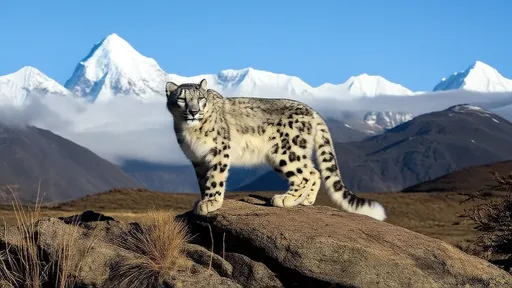
The high-altitude realms of the Himalayas, where the air thins and the temperatures plummet, are home to one of nature’s most elusive predators—the snow leopard. Often referred to as the "ghost of the mountains," this enigmatic big cat roams the rugged terrain at elevations of up to 5,000 meters, its presence more a whisper than a roar. Unlike its more conspicuous feline cousins, the snow leopard thrives in isolation, its survival intricately tied to the harsh, unforgiving landscape it calls home.
Shrouded in mystery, the snow leopard’s ghostly reputation stems from its solitary and secretive nature. With a coat of thick, smoky-gray fur dappled with dark rosettes, it blends seamlessly into the rocky outcrops and snow-covered slopes. This natural camouflage, combined with its cautious behavior, makes sightings exceptionally rare. For the indigenous communities of the Himalayas, the snow leopard is both a spiritual symbol and a silent guardian of the high mountains, its fleeting appearances regarded as omens or blessings.
The challenges of studying this apex predator are as formidable as the terrain it inhabits. Researchers brave sub-zero temperatures, treacherous climbs, and thin air to gather even the most basic data. Camera traps and satellite collars have provided glimpses into the snow leopard’s world, revealing a creature of remarkable adaptability. It navigates sheer cliffs with effortless grace, preys on blue sheep and ibex with lethal precision, and claims vast territories that span hundreds of square kilometers. Yet, despite these technological advances, much of its life remains a puzzle.
Climate change and human encroachment pose existential threats to the snow leopard’s fragile ecosystem. As temperatures rise, the tree line creeps higher, shrinking the alpine meadows that sustain its prey. Herders, competing for grazing land, sometimes retaliate against snow leopards that take livestock, further straining the delicate balance. Conservation efforts, spearheaded by local and international organizations, aim to mitigate these conflicts through community-based initiatives, promoting coexistence between humans and the mountain ghost.
The snow leopard’s future hinges on our ability to protect not just the species, but the entire high-altitude ecosystem it represents. Its survival is a barometer for the health of the Himalayas, a region often called the "Third Pole" for its vast ice reserves. Losing the ghost cat would mean losing a vital thread in the intricate web of life that sustains one of the planet’s most extreme environments. For now, the snow leopard endures—a silent, shadowy figure moving through the snow, as much a part of the mountains as the wind and the stone.
In recent years, ecotourism has emerged as a double-edged sword in snow leopard conservation. While it generates much-needed revenue for local communities and raises awareness, the influx of tourists risks disturbing the very animals they come to admire. Strict guidelines and limited access are enforced in protected areas, ensuring that human presence does not become another threat. For those fortunate enough to catch a glimpse of the ghost cat, the experience is transformative—a fleeting connection with one of the wild’s most elusive spirits.
The cultural significance of the snow leopard cannot be overstated. In the folklore of Himalayan peoples, it is often depicted as a wise and mystical being, a guardian of sacred landscapes. These stories, passed down through generations, reflect a deep respect for the natural world and its inhabitants. Modern conservation strategies increasingly recognize the value of integrating traditional knowledge with scientific research, creating a more holistic approach to protecting the species.
Technology continues to play a pivotal role in unraveling the snow leopard’s secrets. Advances in genetic analysis, for instance, have shed light on population dynamics and genetic diversity, offering hope for more targeted conservation efforts. Meanwhile, drones and high-resolution imaging are being tested to monitor remote habitats without intruding on the animals’ solitude. Each innovation brings us closer to understanding—and ultimately preserving—this majestic creature.
Yet, for all our tools and knowledge, the snow leopard remains an enigma. It is a reminder of nature’s resilience and its fragility, a symbol of wild places untouched by human hands. To protect it is to acknowledge our responsibility to the planet’s most vulnerable ecosystems. The ghost of the Himalayas may vanish into the mist, but its legacy must endure—not just as a marvel of evolution, but as a testament to the beauty and mystery of the natural world.
By /Jun 10, 2025
By /Jun 10, 2025
By /Jun 10, 2025
By /Jun 10, 2025
By /Jun 10, 2025
By /Jun 10, 2025
By /Jun 10, 2025
By /Jun 10, 2025
By /Jun 10, 2025
By /Jun 10, 2025
By /Jun 10, 2025

By /Jun 10, 2025
By /Jun 10, 2025
By /Jun 10, 2025
By /Jun 10, 2025
By /Jun 10, 2025
By /Jun 10, 2025
By /Jun 10, 2025
By /Jun 10, 2025
By /Jun 10, 2025
