In the dense rainforests of New Guinea, a spectacle of nature unfolds that has captivated scientists and bird enthusiasts alike. The Birds-of-Paradise, particularly the species native to Papua, perform some of the most elaborate and visually stunning courtship rituals in the animal kingdom. These displays are not merely about reproduction; they are a testament to the power of aesthetic evolution, where beauty and artistry play a pivotal role in survival.
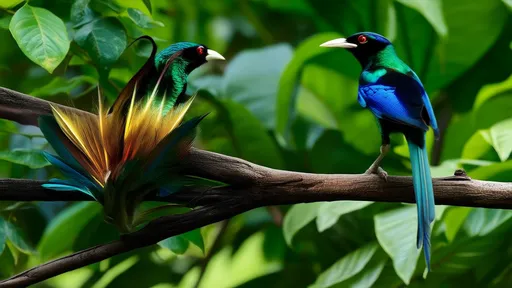
The male Papuan Bird-of-Paradise is a master of performance. With iridescent plumage that shimmers in the filtered sunlight, he transforms into a living work of art. His feathers, ranging from deep velvety blacks to vibrant yellows and electric blues, are meticulously arranged during courtship. Each movement is deliberate, each pose calculated to highlight his most attractive features. The females, often more subdued in coloration, observe these displays with a critical eye, their choices shaping the evolution of these extravagant traits over generations.
What makes these rituals even more fascinating is the diversity among species. Some birds create elaborate stages, clearing patches of forest floor to ensure an unobstructed view of their performance. Others prefer the canopy, using the dappled light to enhance their colors. The Magnificent Riflebird, for instance, spreads its wings like a glossy black fan, while the King of Saxony Bird-of-Paradise waves its extraordinary head plumes in hypnotic patterns. Each species has developed a unique visual language, a dialect of desire spoken through feathers and movement.
Scientists have long debated why such extreme beauty evolves. One theory suggests that in environments where survival is relatively easy—thanks to abundant food and few predators—females can afford to be choosy. They select mates not for strength or practicality, but for traits that indicate genetic superiority. A male who can sustain such extravagant plumage and energetically costly displays must be exceptionally fit. Thus, the aesthetics of courtship become a proxy for health and vitality, ensuring that only the best genes are passed on.
Local indigenous cultures have woven these birds into their myths and traditions. For centuries, the plumes of Birds-of-Paradise have been used in ceremonial dress, symbolizing status and spiritual connection. The Huli people of Papua New Guinea, for example, incorporate the feathers into their iconic wigs during sing-sings (cultural festivals). This human appreciation mirrors the birds’ own courtship—both are celebrations of beauty and identity.
Yet, this natural wonder faces growing threats. Deforestation and habitat fragmentation are shrinking the stages upon which these avian performers rely. Illegal hunting for their prized feathers, though less common today, once pushed some species to the brink. Conservation efforts are now critical to preserving not just the birds themselves, but the ecological theaters in which their dramas unfold. Organizations working with local communities have found success in promoting eco-tourism, turning the birds’ allure into a sustainable lifeline for both wildlife and people.
To witness a Bird-of-Paradise in full display is to see evolution’s creativity unleashed. There is no functional reason for feathers to twist into spiral wires or for capes of velvet black to cascade down a bird’s back—except that somewhere in history, a female preferred it that way. In New Guinea’s forests, beauty is not arbitrary; it is a language, a competition, and a lifeforce all its own. As researchers continue to decode these displays, one truth becomes clear: in the realm of the Birds-of-Paradise, art and survival are one and the same.
By /Jun 10, 2025
By /Jun 10, 2025
By /Jun 10, 2025
By /Jun 10, 2025
By /Jun 10, 2025
By /Jun 10, 2025
By /Jun 10, 2025
By /Jun 10, 2025
By /Jun 10, 2025
By /Jun 10, 2025
By /Jun 10, 2025
By /Jun 10, 2025
By /Jun 10, 2025
By /Jun 10, 2025
By /Jun 10, 2025

By /Jun 10, 2025
By /Jun 10, 2025
By /Jun 10, 2025
By /Jun 10, 2025
By /Jun 10, 2025
