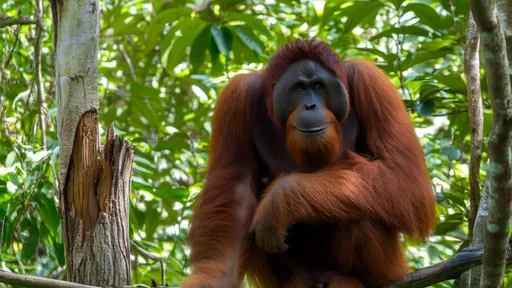
The dense rainforests of Borneo have long been a sanctuary for one of humanity's closest relatives—the Bornean orangutan. With their striking auburn fur and thoughtful, almost human-like expressions, these great apes have captivated researchers and wildlife enthusiasts alike. Yet beneath the emerald canopy that has sheltered them for millennia, a quiet crisis unfolds. Rampant deforestation, driven by palm oil plantations, logging, and agricultural expansion, has pushed these magnificent creatures to the brink of extinction.
For generations, the Bornean orangutan has thrived in the island's lush lowland forests, where towering dipterocarp trees provide both food and shelter. Their existence is intricately tied to the health of these ecosystems; they are what scientists call an "umbrella species." Protecting them means preserving countless other species that share their habitat. But as chainsaws roar and flames consume vast tracts of jungle, their world shrinks at an alarming pace. Satellite imagery reveals a patchwork of scarred land where uninterrupted wilderness once stood.
The plight of the orangutan is not just an environmental issue—it's a cultural tragedy. Indigenous communities, such as the Dayak people, have coexisted with these apes for centuries, weaving them into folklore and spiritual beliefs. To them, the orangutan is not merely an animal but a guardian of the forest. Modern economic pressures, however, have disrupted this balance. Traditional swidden agriculture, which once operated in harmony with nature, is increasingly replaced by monocultures that offer little refuge for wildlife.
Conservationists face a race against time. Rehabilitation centers across Borneo work tirelessly to rescue orphaned orangutans, many of whom watched their mothers die at the hands of poachers or plantation workers. These centers, such as the renowned Sepilok Orangutan Rehabilitation Centre in Sabah, offer a glimmer of hope. Young orangutans are taught the skills they would have learned in the wild—climbing, foraging, and avoiding predators. But reintroducing them into the wild is fraught with challenges. Where can they go when their natural habitat disappears by the day?
International attention has brought some progress. Certification schemes for sustainable palm oil, like the Roundtable on Sustainable Palm Oil (RSPO), aim to curb deforestation. Yet enforcement remains weak, and illegal logging persists. Meanwhile, climate change exacerbates the crisis. Prolonged droughts, linked to El Niño events, have turned degraded forests into tinderboxes. The wildfires that follow not only claim orangutan lives but also release vast amounts of carbon dioxide, fueling a vicious cycle of environmental degradation.
The story of the Bornean orangutan is a microcosm of a global dilemma. Their survival hinges on a delicate interplay of ecology, economics, and ethics. While documentaries and viral videos have raised awareness, tangible action lags behind. Ecotourism, when managed responsibly, offers a potential middle ground—providing income for local communities while safeguarding habitats. But without systemic change, even the most resilient of these red-haired apes may find their final refuge gone.
What emerges from the shadows of Borneo's vanishing forests is a sobering truth: the fate of the orangutan is a mirror to our own. In saving them, we might just save ourselves. The question that lingers, heavy as the tropical air, is whether we will act before it's too late—or bear witness to the silencing of one of the planet's most intelligent and gentle creatures.
By /Jun 10, 2025
By /Jun 10, 2025

By /Jun 10, 2025

By /Jun 10, 2025
By /Jun 10, 2025
By /Jun 10, 2025
By /Jun 10, 2025
By /Jun 10, 2025

By /Jun 10, 2025
By /Jun 10, 2025
By /Jun 10, 2025

By /Jun 10, 2025

By /Jun 10, 2025

By /Jun 10, 2025
By /Jun 10, 2025

By /Jun 10, 2025
By /Jun 10, 2025

By /Jun 10, 2025

By /Jun 10, 2025
By /Jun 10, 2025
