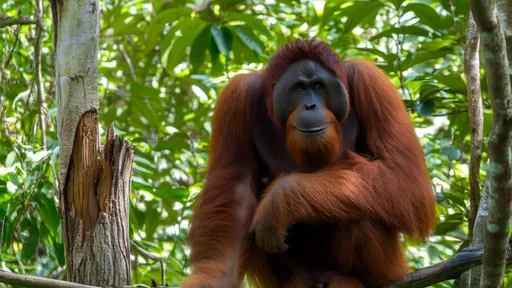
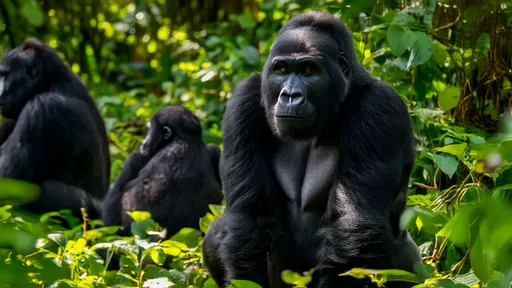
The dense rainforests of the Congo Basin are home to one of nature's most fascinating social structures—the lowland gorilla troops. These majestic creatures, often overshadowed by their mountain-dwelling cousins, exhibit complex family dynamics that mirror human politics in unexpected ways. Unlike the solitary orangutan or the chaotic chimpanzee troops, gorillas thrive in tightly knit family units where power, loyalty, and even diplomacy play crucial roles in daily survival.
At the heart of every gorilla family is the silverback, a dominant male whose authority is rarely challenged outright. His presence is both a shield and a shackle for the group. The silverback dictates movement, mediates conflicts, and even decides when it's time to rest. But his rule isn't tyrannical; it's earned through a combination of physical strength and subtle charisma. Younger males may linger on the periphery, biding their time, but outright rebellion is rare. Instead, they often leave to form their own groups, avoiding bloody coups that would destabilize the troop.
What's striking is how female gorillas navigate this patriarchal system. Though physically smaller, they wield significant influence through choice. Females voluntarily transfer between groups, often selecting silverbacks based on perceived protection or resources. This quiet power—the ability to vote with their feet—forces males to maintain favorable conditions lest they lose their breeding partners. A silverback with too many females may struggle to prevent infanticide from rival males, while one with too few risks genetic stagnation. The balance is delicate, and the females know it.
Juveniles and infants add another layer to this political tapestry. Play sessions among youngsters aren't just for fun; they're rehearsals for adulthood. Watch long enough and you'll see future alliances forming—young males practicing dominance displays, females learning nurturing behaviors. Even the silverback tolerates their antics, perhaps recognizing that today's playful bite could be tomorrow's loyal defender. The troop's survival depends on these bonds being forged early.
Conflict resolution among gorillas lacks the drama of chimpanzee warfare but is no less sophisticated. Disputes over food or mating access rarely escalate to violence. Instead, the silverback intervenes with a mere glance or strategic positioning. Subordinates employ "appeasement gestures"—soft grunts, exaggerated chewing—to diffuse tension. Remarkably, defeated rivals often remain with the group rather than face solitary exile. This emphasis on cohesion over expulsion hints at an evolutionary wisdom humans might envy.
The rainforest itself shapes these politics. Unlike open savannas where visibility aids despotism, dense foliage limits any one gorilla's oversight. Silverbacks must trust their females not to wander; females must trust the male to detect hidden threats. This mutual dependence fosters a unique blend of autonomy and collectivism. When a troop feeds on fig trees, the hierarchy relaxes—an unspoken truce where nourishment temporarily outweighs status.
Human encroachment adds tragic complexity to these dynamics. Deforestation fractures territories, forcing unnatural interactions between groups. Poaching often targets silverbacks, leaving leaderless troops vulnerable to disintegration. Conservationists report eerie behavior in such cases—adolescent males attempting premature dominance, mothers clinging to deceased infants for weeks. The very social fabric that sustained gorillas for millennia begins unraveling under anthropogenic pressures.
Yet there's resilience in these familial bonds. Researchers documented a rare event where a deposed silverback was reintegrated into his former group after losing a challenge. The victor, perhaps recognizing experience mattered more than pride, allowed the elder to stay as a sentinel of sorts. Such flexibility suggests gorilla politics aren't rigid dictatorships but adaptive systems honed by evolution.
To observe Congo's lowland gorillas is to witness governance stripped to its essentials: power tempered by responsibility, individuality balanced against collective need. Their world lacks speeches or elections, yet the negotiations never cease—a reminder that politics, in its purest form, predates humanity itself.
By /Jun 10, 2025
By /Jun 10, 2025
By /Jun 10, 2025

By /Jun 10, 2025
By /Jun 10, 2025
By /Jun 10, 2025

By /Jun 10, 2025
By /Jun 10, 2025

By /Jun 10, 2025
By /Jun 10, 2025

By /Jun 10, 2025
By /Jun 10, 2025
By /Jun 10, 2025

By /Jun 10, 2025
By /Jun 10, 2025

By /Jun 10, 2025
By /Jun 10, 2025

By /Jun 10, 2025

By /Jun 10, 2025
By /Jun 10, 2025
